Explainers
May 29, 2026
What is a Semiconductor, and What Does It Actually Do?
Rafiq Omair
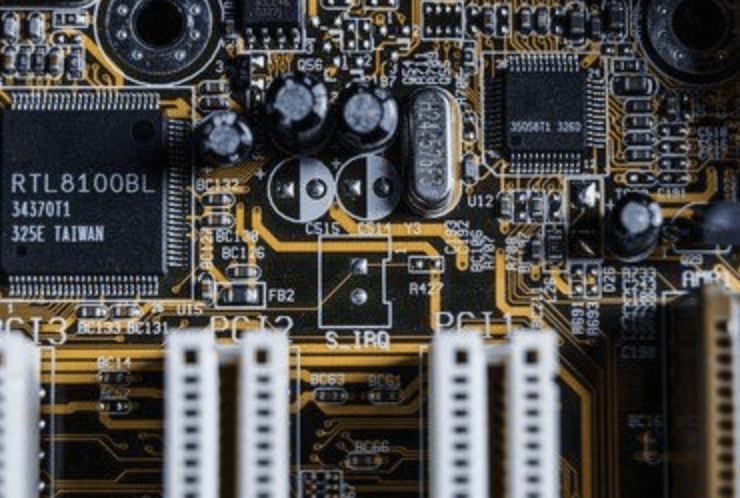
If you opened up a phone, peeled back the screen, and stared at the main chip under a microscope, you would be looking at billions of tiny switches packed into a fingernail-sized square. Every one of those switches is made from a semiconductor.
We say the word constantly. Semiconductor shortage. Semiconductor fabs. Semiconductor war. But what is a semiconductor, really, and what is it actually doing inside your electronics?
A material that sits between two extremes
Materials can usually be sorted into two camps when it comes to electricity.
Conductors: materials like copper or aluminium that let current flow easily. Electrons in these metals are loosely held and happy to move when pushed.
Insulators: materials like glass or rubber that resist current strongly. Their electrons are locked into place and refuse to move.
A semiconductor sits in the middle. Silicon, the most common one, barely conducts on its own. Pure silicon at room temperature is closer to an insulator than a conductor.
That sounds boring until you realize the magic: we can tune how well a semiconductor conducts. We can do it with heat, with light, with voltage, and most importantly, by adding tiny amounts of other elements.
Doping: the trick that makes everything work
Take pure silicon and mix in a sprinkle of phosphorus. Phosphorus has one more electron than silicon does, and that extra electron is loose. The material now has free electrons that can carry current. We call this n-type silicon (n for negative charge carriers).
Now take pure silicon and mix in boron instead. Boron has one less electron than silicon, which leaves behind little gaps where electrons should be. These gaps act like positively charged particles that can move around. We call this p-type silicon (p for positive).
The process of adding these impurities is called doping, and the amounts are tiny. We are talking parts per million or even parts per billion. A few well-placed atoms is all it takes to flip silicon from nearly useless to enormously powerful.
The p-n junction: where the action starts
The real magic happens when you put a piece of p-type silicon right next to a piece of n-type silicon. At the boundary, free electrons from the n side rush over to fill gaps on the p side, and you get a thin zone where charges balance out. This zone is called the depletion region, and it acts a bit like a one-way gate for current.
This junction is the foundation of the diode, which lets current flow one direction and blocks it the other. It is also the foundation of solar cells, LEDs, and almost every other building block in modern electronics.
Transistors: switches that do not move
Stack p-type and n-type silicon in just the right pattern, and you get a transistor. The most common kind today is called a MOSFET (metal-oxide-semiconductor field-effect transistor).
What a transistor does is simple in concept. A small voltage on one terminal controls whether current can flow between two other terminals. It is a switch with no moving parts, no wear, and no sound. It can flip on and off billions of times per second.
That single trick, repeated billions of times in one chip, is how computers think.
A transistor that is on can represent a 1.
A transistor that is off can represent a 0.
Combine them, and you can store memory, do arithmetic, run code, and play video.
Every CPU, GPU, memory chip, microcontroller, and image sensor is built on this idea.
Why we cannot just use copper for everything
A reasonable question: if conductors carry current easily, why not just use them and skip the semiconductor weirdness?
Because copper cannot switch. Copper is always on. It carries current whenever you let it. To build logic, memory, and signal processing, you need a material whose conductivity you can control with a knob, and semiconductors are the only practical answer we have found.
That ability to be controlled is what makes them special. Not the conducting, not the insulating, but the in-between behaviour that we can shape with doping and voltage.
The other semiconductors
Silicon dominates because it is cheap, abundant, and well understood. But other semiconductors exist, and each has its niche.
Gallium arsenide (GaAs) is faster than silicon at high frequencies, common in radio and satellite electronics.
Silicon carbide (SiC) handles high voltages and high temperatures better, used in electric vehicle power systems.
Gallium nitride (GaN) is showing up in fast phone chargers and high-frequency power applications.
Germanium was the original semiconductor used in early transistors before silicon took over.
Each is a different compromise between speed, voltage handling, manufacturing cost, and thermal performance.
Why this matters for students
Semiconductors are not just a topic in an electronics course. They sit underneath almost every modern device, every clean energy technology, every form of computing, and most of the supply chains people argue about on the news.
Understanding what a semiconductor actually is gives you a foothold in microelectronics, power electronics, photonics, sensors, and energy systems. It is one of those topics where a small amount of clear intuition unlocks a huge amount of practical knowledge later.
So next time you hear "semiconductor," picture a material that sits between a conductor and an insulator, doped with impurities to control how it carries charge, arranged into junctions and transistors that switch in lockstep with everything else on a chip.
That is the engine of modern technology, hiding in plain sight.